ACEM Primary Exam Prep: One Question at a Time


Medical teaching is often at its best for both students and educators when it is practical, interactive, and grounded in real-life practice. In reality, educators are usually balancing limited time, busy clinical workloads, curriculum requirements, and the challenge of keeping learners engaged.
Over time, we have spoken to educators who felt overwhelmed at the prospect of building entire courses and programs from scratch - curating materials from multiple online resources, stitching them together into a logical module, while also trying to make them interactive and engaging for students.
The educator features on eMedici were built to support existing teaching practices in a structured and accessible way, helping educators save time so they can prioritise teaching delivery rather than searching for appropriate materials.
Rather than replacing how educators teach, the goal is simply to make it easier to find useful material, organise sessions, and create opportunities for active learning.
One of the things educators often mention is wanting resources that are relevant to Australian clinical practice and appropriate for different stages of training.
eMedici’s content is written and reviewed by Australian clinicians and educators, with material aligned to Australian undergraduate and postgraduate curricula.
The platform includes resources across all stages of medical training, from pre-clinical years through to fellowship exams and beyond. This includes MCQs, case studies, OSCE stations, tutorials, and mock exams across multiple disciplines.
This breadth allows educators to adapt the platform to different teaching styles without needing to build entirely new resources from scratch.
A common frustration in medical education is the amount of time it takes to locate good questions or cases for teaching.
The Question Bank Search feature allows educators to search by specialty, diagnosis, presentation, investigation, topic, or difficulty level.
This can be helpful for structured curriculum teaching. For example, educators can pull together content in specific areas such as:
Dermatology MCQs
Updated Asthma handbook MCQs
Cardiovascular disease Case Studies
Common OSCE stations
The emphasis is less on “delivering content” and more on creating discussion and clinical reasoning opportunities.
One feature many educators find useful is Collections. Collections allow educators to save MCQs, case studies, and OSCE stations into grouped sets that can later be shared with learners.
This can be used for:
Pre-reading activities before tutorials
Flipped classroom teaching
Revision sessions
Reinforcing learning after teaching
Because the material stays on-platform, it can make teaching sessions easier to organise without relying on multiple documents, links, or slides.
Educators can also structure learning in a way that mirrors clinical reasoning. A session might begin with a patient case, move into MCQs that explore key concepts, and finish with OSCE practice or discussion.
Large group teaching can sometimes make it difficult to know whether learners are following along or actively engaging.
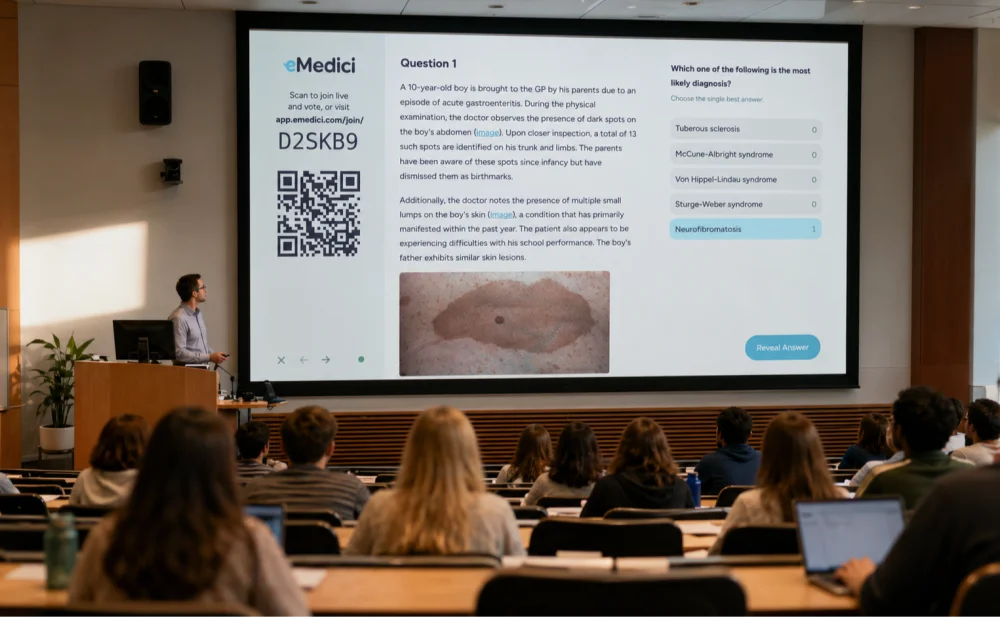
The eMedici platform includes a built-in Audience Response System (ARS), designed to support interactive teaching by allowing learners to respond to questions live through polling.
Educators can use this in different ways:
Individual response polling
Think-Pair-Share activities
Team-based learning
Revision quizzes
What often matters most is not necessarily whether learners get the question right immediately, but the discussion that follows - including why an answer was chosen and addressing misconceptions.
For many educators, the live polling feature creates an easier way to facilitate those conversations.
The case studies and tutorials on eMedici are structured around patient journeys and clinical decision-making.
Rather than isolated learning points, learners move through presentations, investigations, management decisions, and interpretation of findings with integrated questions along the way.
These cases can work well in:
Small group tutorials
Flipped classroom sessions
Pre-reading
Self-directed learning
They also help create a more consistent learning experience across different teaching groups, including rural clinical schools and geographically dispersed learners, as well as across different tutors.
Organising OSCE teaching can sometimes be logistically difficult, especially when coordinating stations, timing, marking, and participant roles.
eMedici’s OSCE features are designed to simplify that process. Educators can search for stations by specialty or topic, save them into Collections, and run structured practice sessions either in person or virtually.
The platform includes:
Modifiable station timings
Integrated bell sound
Examiner marking sheets and marking guides
Standardised patient instructions
Functionality to support interactive group practice
For tutors and clinical schools, this can make it easier to run consistent OSCE practice sessions while still allowing flexibility in teaching delivery either online or in-person.
 Lucas Kim
You
Lucas Kim
You
 Ava Mitchell
 Sophie Caldwell
Ultimately, good medical teaching still comes down to educators themselves - the discussions they facilitate, the clinical insights they share, and the learning environments they create.
The eMedici platform is simply a tool to support this process.
The Educators’ Access Program was developed to give academics and titleholders at Australian and New Zealand medical schools access to resources for teaching purposes. Educators can register at this online form.
Hannah is Editor-in-Chief at eMedici. She is a General Practitioner with Fellowship of the Royal Australian College of General Practitioners (FRACGP) as well as University academic, based in Adelaide, South Australia. She completed her MBBS at the University of Adelaide in 2015 and Master of Clinical Education at Flinders University in 2017. Hannah is also Fellow of the Higher Education Academy, Fellow of the Academy of Medical Educators, and Associate Fellow of the Australian and New Zealand Association for Health Professional Educators.
She joined eMedici in 2014 as a contributor of MCQs and now oversees all content on the platform. She enjoys engaging with the wider Community of Practice at eMedici (universities, students, editors, reviewers) and working with like-minded peers to drive innovation in the delivery of digital health professions education.
ACEM Primary Exam Prep: One Question at a Time
 GP Exam Prep: What Actually Helps

 Getting Into the Groove of GP Registrar Life
 A Practical Guide to Medical Internship Applications